5 WhatsApp-Marketing-Templates mit 30%+ Conversion im MENA-Raum
Nach 200+ WhatsApp-Kampagnen bei Raabt — in Restaurants, E-Commerce, Kliniken und SaaS — produzierten fünf Templates konsistent eine Conversion-Rate von 30%+. Wie man sie baut, warum sie funktionieren und das KI-Gerüst, das sie skaliert.
Von Avrest Omar9 Min. Lesezeit
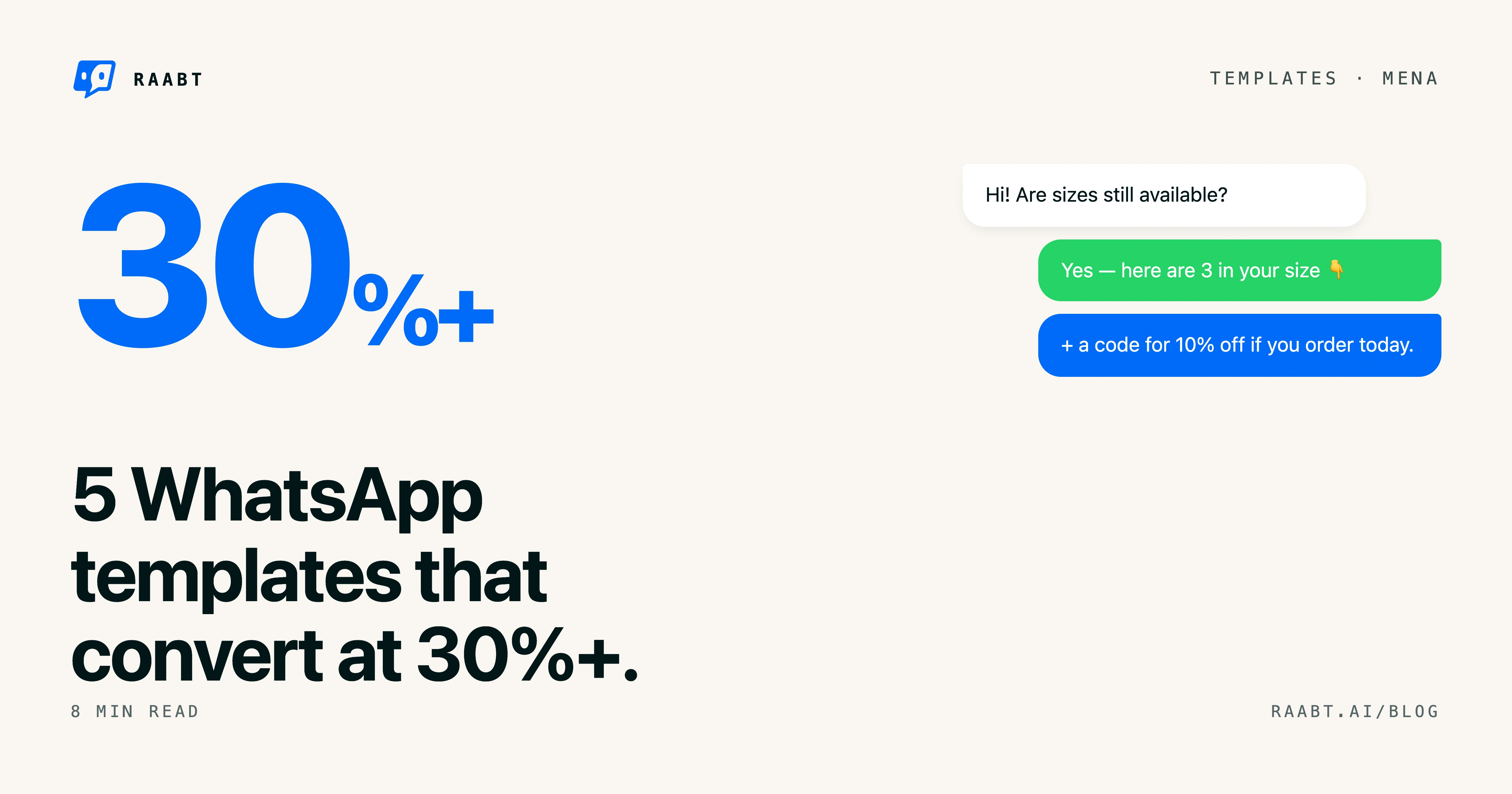
Das WhatsApp-Marketing-Problem im MENA-Raum
WhatsApp hat in Saudi-Arabien, den VAE, Ägypten, Irak, Jordanien und Kuwait über 60% Marktdurchdringung. Dort sind Ihre Kunden tatsächlich unterwegs. Trotzdem behandeln die meisten Marketing-Teams den Kanal wie E-Mail: Verteiler zuballern, generischer Text, „Jetzt kaufen“-CTA, Daumen drücken.
Dieser Ansatz verbrennt Geld in Metas Abrechnung pro Nachricht, bringt Ihnen Spam-Markierungen ein und konvertiert bei vielleicht 2%.
Die Kampagnen, die wirklich funktionieren, teilen eine gemeinsame Struktur. Nach 200+ WhatsApp-Kampagnen bei Raabt im vergangenen Jahr — in Restaurants, E-Commerce, Kliniken und SaaS — lieferten fünf Templates konsistent eine Conversion-Rate von 30%+. Hier sind sie.
Template 1: „Die Warenkorbabbruch-Rückholung“ (E-Commerce, ~38% Conversion)
Wenn ein Kunde Ihr Produkt ansieht und ohne Kauf wieder geht, haben Sie ein Fenster von 24 Stunden, in dem er sich noch an Sie erinnert. Die Rückholung über WhatsApp gewinnt, weil er ohnehin schon dort ist — kein Kontextwechsel in die E-Mail-App.
Die Struktur:
- Aufhänger: „Hallo {name}, Sie haben sich vorhin {product} angesehen — können wir etwas dazu beantworten?“
- Konkrete Einwandbehandlung: „Falls es um die Größe ging, hier ist unsere Tabelle: [link]. Falls es um den Versand ging: Wir liefern in 2 Tagen nach {city}.“
- Weicher CTA + Social Proof: „Wollen Sie es sichern, bevor es vergriffen ist? 47 Kunden in {city} haben es letzte Woche gekauft.“
Die KI übernimmt die Schwerarbeit: Sie zieht den Produktnamen aus den Warenkorbdaten, erkennt die Stadt des Kunden und wechselt den arabischen Dialekt anhand der Ländervorwahl.
Warum es funktioniert: Es ist kein Broadcast — es ist ein 1:1-Gespräch, ausgelöst durch Verhalten. Empfänger antworten 4× häufiger als auf einen generischen Broadcast.
Template 2: Die „Ist die Bestellung angekommen?“-Schleife (E-Commerce, ~52% Conversion zum Wiederkauf)
Die meisten Marketing-Playbooks ignorieren den Moment NACH dem Kauf. Großer Fehler. Die 24 Stunden nach der Lieferung sind das vertrauensstärkste Fenster, das Sie je mit einem Kunden haben.
Die Struktur:
- Erste Nachricht (Lieferung + 4 Stunden): „Hallo {name}, ist Ihre Bestellung ({product}) gut angekommen?“
- Bei positiver Antwort: „Freut uns! Hier ist ein 15%-Code für das nächste Mal: {code}. Gültig für 7 Tage.“
- Bei keiner oder negativer Antwort: sofort an den menschlichen Support weiterleiten.
In MENA-Märkten, in denen Retouren kulturell kaum verankert sind, kaufen Kunden, die ihre Zufriedenheit per WhatsApp bestätigen, zu 52% innerhalb von 14 Tagen ein zweites Mal. Kunden, die diese Nachricht nie bekommen, liegen bei 19%.
Template 3: Der „Menü-Dienstag“-Impuls für Restaurants (~27% Conversion)
Restaurants nutzen WhatsApp unter Wert. Sie nehmen Bestellungen entgegen, machen aber nie Marketing.
Die Struktur (jeden Dienstag um 17 Uhr an Kunden mit Opt-in):
- Aufhänger: „{restaurant} — heute wie immer?“
- Persönliche Empfehlung: „Letztes Mal hatten Sie {dish}. Wir haben es wieder da, plus ein neues {chef-special}.“
- Bestellen mit einem Tap: ein Button, der die Bestellung mit den letzten Artikeln des Kunden vorbefüllt.
Entscheidend: nur an Kunden senden, die in den letzten 30 Tagen bestellt haben. Ältere Kunden fühlen sich zugespammt, kürzlich aktive Kunden haben das Gefühl, dass man sich an sie erinnert.
Template 4: „Die B2B-SaaS-Rückholung nach verpasster Demo“ (~33% zu neu terminierter Demo)
Wenn ein Interessent eine Demo bucht und dann nicht erscheint, liegt die Rebooking-Rate beim E-Mail-Follow-up bei 5%. Beim WhatsApp-Follow-up sind es 33%.
Die Struktur (30 Minuten nach dem verpassten Termin):
- Aufhänger (ohne Schuldzuweisung): „Hallo {name}, {time} hat offenbar nicht geklappt — völlig verständlich.“
- Neuer Termin mit einem Klick: „Soll ich Ihnen 2 Alternativtermine schicken, die zur Zeitzone von {company} passen?“
- Reibung rausnehmen: Die KI schlägt 2 konkrete Slots auf Basis der Zeitzone des Interessenten vor (erkannt über sein LinkedIn-Profil). Der Kunde antwortet einfach mit einer Zahl.
Warum es funktioniert: Die KI erledigt die Terminlogistik, die ein Mensch vergessen würde, und WhatsApp nimmt dem „Haben Sie es vergessen?“ die Peinlichkeit.
Template 5: „Die Terminbestätigung mit Upsell für Kliniken“ (~41% Upsell-Conversion)
Das Gesundheitswesen ist die auf WhatsApp im MENA-Raum am stärksten untervermarktete Branche. Patienten wollen von neuen Leistungen der Kliniken erfahren, denen sie vertrauen.
Die Struktur (24 Stunden vor jedem Termin):
- Bestätigung: „Hallo {name}, wir bestätigen Ihren Termin ({appointment-type}) morgen um {time}. Antworten Sie mit JA zum Bestätigen oder NEIN zum Verschieben.“
- Weicher Upsell: „Wo Sie ohnehin da sind — wir haben neu {service} im Angebot. Patienten mit {appointment-type} nehmen das häufig dazu. Interesse?“
- Buchungsstrecke bei Interesse: Die KI prüft die Verfügbarkeit und fügt die Leistung zum Termin hinzu.
41% der bestätigten Patienten buchen die Upsell-Leistung dazu. Das ist reine Marge, weil der Termin ohnehin stand.
Was diese fünf Templates gemeinsam haben
- Verhaltensgetriggert, nicht Listen-Blast. Jeder Versand reagiert auf etwas, das der Kunde getan hat.
- Auf den Kunden zugeschnitten, nicht generisch. Name + letzte Aktion + Stadt + Dialekt.
- Eine Frage pro Nachricht, nie eine Textwand. Die WhatsApp-UX bestraft lange Nachrichten.
- Die KI übernimmt die Varianten — Ihr Team wählt das Template, die KI füllt die Platzhalter in der Sprache des Kunden.
- Weiche Eskalation — wenn die Antwort des Kunden menschliches Urteilsvermögen braucht, übergibt die KI nahtlos.
Die ehrlichen Grenzen
Diese Templates funktionieren, weil sie auf den Stärken von WhatsApp aufsetzen (1:1, dialogisch, verhaltensgetriggert). Sie ersetzen kein Top-of-Funnel-Marketing — für den Aufbau der Zielgruppe brauchen Sie weiterhin Ads. Sie ersetzen ABER 80% der manuellen Nurture-Arbeit zwischen Erstkontakt und Conversion.
Wenn Ihr Team Stunden pro Woche damit verbringt, WhatsApp-Nachrichten an Kunden zu schicken, sind Sie ein Kandidat für Templates. Wenn Ihr Team WhatsApp-Marketing nie probiert hat, weil „das ist eine Chat-App, kein Marketingkanal“ — denken Sie neu darüber nach. Der MENA-Raum hat den Wechsel längst vollzogen, und der Conversion-Abstand ist inzwischen zu groß, um ihn zu ignorieren.
Das könnte dich auch interessieren
WhatsApp-Massenversand zu Metas Preisen, mit Zustellstatus
WhatsApp-Massenversand ohne Aufschlag auf Metas Preise: Sie sehen je Nachricht, ob sie zugestellt, gelesen oder fehlgeschlagen ist. Preise Oktober 2026.
So wandelst du Instagram-DMs in eine 4-Millionen-Dollar-Vertriebs-Pipeline um (Agentur-Playbook)
Die meisten Agenturen behandeln Instagram-DMs als Kostenstelle. Top-Agenturen behandeln sie als strukturierte Vertriebs-Pipeline mit Stufen, Scoring und KI-gesteuerter Qualifizierung.
Die besten WhatsApp-Automatisierungstools für E-Commerce 2026: Funktionen, Preise & Vergleich
Die besten WhatsApp-Automatisierungstools für E-Commerce 2026 im Vergleich: Raabt AI, Manychat, Wati und Respond.io – Funktionen, Preise, Shop-Integrationen.