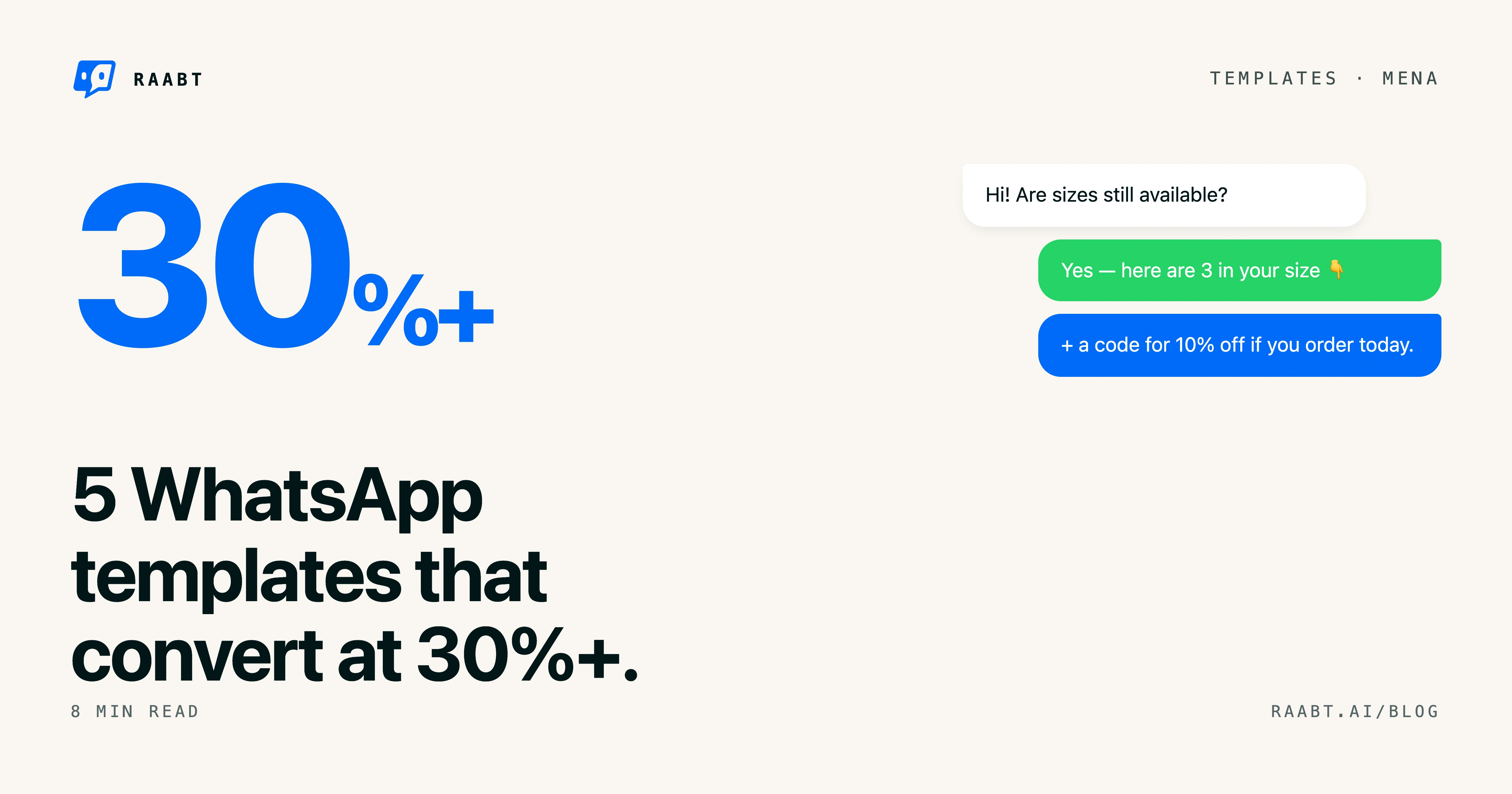
5 Plantillas de Marketing WhatsApp que Convierten al 30%+ en MENA
Después de ejecutar más de 200 campañas WhatsApp en Raabt — en restaurantes, e-commerce, clínicas y SaaS — cinco plantillas produjeron una tasa de conversión consistente de 30%+. Cómo construirlas, por qué funcionan, y el andamiaje IA que las escala.
Por Avrest Omar9 min de lectura
El problema del marketing por WhatsApp en MENA
WhatsApp supera el 60% de penetración de mercado en Arabia Saudita, EAU, Egipto, Irak, Jordania y Kuwait. Ahí es donde de verdad viven tus clientes. Pero la mayoría de los equipos de marketing lo trata como el email: lista masiva, copy genérico, CTA de "compra ya" y a cruzar los dedos.
Ese enfoque te quema el presupuesto con el precio por mensaje de Meta, te marca como spam y convierte, con suerte, a un 2%.
Las campañas que sí funcionan comparten una estructura. Después de ejecutar más de 200 campañas de WhatsApp en Raabt durante el último año — en restaurantes, e-commerce, clínicas y SaaS — cinco plantillas produjeron una tasa de conversión sostenida de más del 30%. Aquí están.
Plantilla 1: Recuperación de "carrito abandonado" (e-commerce, ~38% de conversión)
Cuando un cliente mira tu producto y se va sin comprar, tienes una ventana de 24 horas en la que todavía te recuerda. La recuperación por WhatsApp gana porque es donde el cliente ya está: sin cambiar de contexto a la app de email.
La estructura:
- Gancho: "Hola {nombre}, estabas viendo {producto} hace un rato, ¿te resolvemos alguna duda?"
- Manejo de la objeción específica: "Si era por la talla, aquí tienes nuestra tabla de tallas: [enlace]. Si era por el envío, entregamos en {ciudad} en 2 días."
- CTA suave + prueba social: "¿Lo quieres antes de que se agote? 47 clientes en {ciudad} lo compraron la semana pasada."
La IA hace el trabajo pesado: toma el nombre del producto de los datos del carrito, detecta la ciudad del cliente y cambia el dialecto árabe según el código de país del teléfono.
Por qué funciona: no es una difusión, es una conversación 1:1 disparada por el comportamiento. Los destinatarios responden 4× más seguido que a una difusión genérica.
Plantilla 2: El ciclo "¿llegó tu pedido?" (e-commerce, ~52% de conversión a recompra)
La mayoría de los manuales de marketing ignora el momento DESPUÉS de la compra. Error grave. Las 24 horas posteriores a la entrega son la ventana de mayor confianza que vas a tener con un cliente.
La estructura:
- Primer mensaje (entrega + 4 horas): "Hola {nombre}, ¿te llegó bien tu {producto}?"
- Si responde en positivo: "¡Qué bueno! Aquí tienes un código del 15% para la próxima: {código}. Válido por 7 días."
- Si no responde o responde en negativo: derivar a soporte humano de inmediato.
En los mercados de MENA, donde la cultura de devoluciones es débil, un 52% de los clientes que confirman su satisfacción por WhatsApp vuelve a comprar en los 14 días siguientes. Los que nunca reciben ese mensaje convierten al 19%.
Plantilla 3: El recordatorio de "menú de los martes" para restaurantes (~27% de conversión)
Los restaurantes desaprovechan WhatsApp. Toman pedidos, pero nunca hacen marketing.
La estructura (se envía cada martes a las 5 p. m. a los clientes que dieron su consentimiento):
- Gancho: "{restaurante}: ¿lo de siempre hoy?"
- Recomendación personalizada: "La última vez pediste {plato}. Ya lo tenemos de vuelta + un nuevo {especial-del-chef}."
- Pedido con un toque: un botón que precarga el pedido con los últimos artículos del cliente.
Clave: envía solo a clientes que pidieron en los últimos 30 días. Los más antiguos sienten que es spam; los recientes se sienten recordados.
Plantilla 4: Recuperación de "demo no asistida" en SaaS B2B (~33% a demo reagendada)
Cuando un prospecto agenda una demo y desaparece, el seguimiento por email tiene un 5% de reagendamiento. El seguimiento por WhatsApp tiene un 33%.
La estructura (se envía 30 minutos después del horario perdido):
- Gancho (sin culpa): "Hola {nombre}, parece que ese horario no funcionó, lo entiendo perfectamente."
- Reagendar con un clic: "¿Te mando 2 horarios alternativos que funcionen para la zona horaria de {empresa}?"
- Reducir la fricción: la IA propone 2 horarios concretos según la zona horaria del prospecto (detectada desde su LinkedIn). El cliente solo responde con un número.
Por qué funciona: la IA se encarga de la logística de reagendar que una persona olvidaría hacer, y WhatsApp elimina el incómodo tono de "¿se te olvidó?".
Plantilla 5: "Confirmación de cita + upsell" para clínicas (~41% de conversión en upsell)
La salud es la vertical menos explotada de WhatsApp en MENA. Los pacientes quieren enterarse de los nuevos servicios de las clínicas en las que confían.
La estructura (se envía 24 horas antes de cada cita):
- Confirmación: "Hola {nombre}, confirmamos tu {tipo-de-cita} mañana a las {hora}. Responde SÍ para confirmar o NO para reagendar."
- Upsell suave: "Ya que vienes: acabamos de sumar {servicio} a nuestra oferta. Los pacientes que se hacen {tipo-de-cita} suelen agregarlo. ¿Te interesa?"
- Flujo de reserva si le interesa: la IA revisa la disponibilidad y lo agrega a la cita.
El 41% de los pacientes confirmados agrega el servicio del upsell. Es margen puro, porque la cita ya estaba agendada.
Qué tienen en común estas cinco plantillas
- Disparadas por comportamiento, no por lista masiva. Cada envío responde a algo que el cliente hizo.
- Específicas para el cliente, no genéricas. Nombre + última acción + ciudad + dialecto.
- Una pregunta por mensaje, nunca un muro de texto. La UX de WhatsApp castiga los mensajes largos.
- La IA maneja la variación: tu equipo elige la plantilla, la IA rellena los campos en el idioma del cliente.
- Escalamiento suave: cuando la respuesta del cliente necesita criterio humano, la IA hace el traspaso sin fricción.
Las limitaciones honestas
Estas plantillas funcionan porque se apoyan en las fortalezas de WhatsApp (1:1, conversacional, disparadas por el comportamiento). No reemplazan el marketing de la parte alta del embudo: sigues necesitando anuncios para conseguir audiencia. SÍ reemplazan el 80% del trabajo manual de nutrición de leads entre el primer contacto y la conversión.
Si tu equipo pasa horas por semana enviando mensajes de WhatsApp a clientes, eres candidato a trabajar con plantillas. Si tu equipo nunca probó el marketing por WhatsApp porque "es una app de chat, no un canal de marketing", reconsidéralo: MENA ya cambió, y la brecha de conversión ya es demasiado grande para ignorarla.
También te puede interesar
WhatsApp masivo a tarifas de Meta, con acuse de recibo
Envía mensajes masivos de WhatsApp sin recargo sobre las tarifas de Meta y mira si cada uno se entregó, se leyó o falló. Tarifas de octubre 2026 incluidas.
Cómo Convertir DMs de Instagram en un Pipeline de Ventas de $4M (Manual de Agencias)
La mayoría de agencias tratan los DMs de Instagram como un centro de costos. Las agencias top los tratan como un pipeline de ventas estructurado con etapas, scoring y calificación impulsada por IA. Un manual de 5 etapas con las métricas, las plantillas y las matemáticas.
Mejores herramientas de automatización de WhatsApp para e-commerce en 2026: funciones, precios y comparativa
Compara las mejores herramientas de WhatsApp para e-commerce en 2026: Raabt AI, Manychat, Wati y Respond.io según funciones, precios e integraciones.